
A Client Case: What ≈30% Actually Looks Like
In our last post, we made a bold move: we put a number in a contract. A guaranteed ≈30% change in value for our clients, built on 18 months of becoming data-driven, making work flow, practising the 7 Habits of Successful Delivery and treating AI as a targeted intervention rather than a headline. We showed how Monte Carlo simulation replaced gut-feel estimation and how overlaying our Flow Score with an AI usage score proved that AI adoption compounds into real delivery value.
That was the model, validated across the business. This week we bring it down to one case study: one team, one client, one contract.
Numbers don't change on their own
None of it happened because we measured harder, but it happened because we changed how teams work. Leadership, teams and clients all got behind that change at the same time. Measurement showed us where the friction was and the habits removed it. The intent was never "hit a number." The intent was to change how delivery actually happens and let the number follow.
When leadership, teams and clients commit to that shift together, that's when the compounding starts. Here's what it looked like for one of our teams.
One team, twelve months
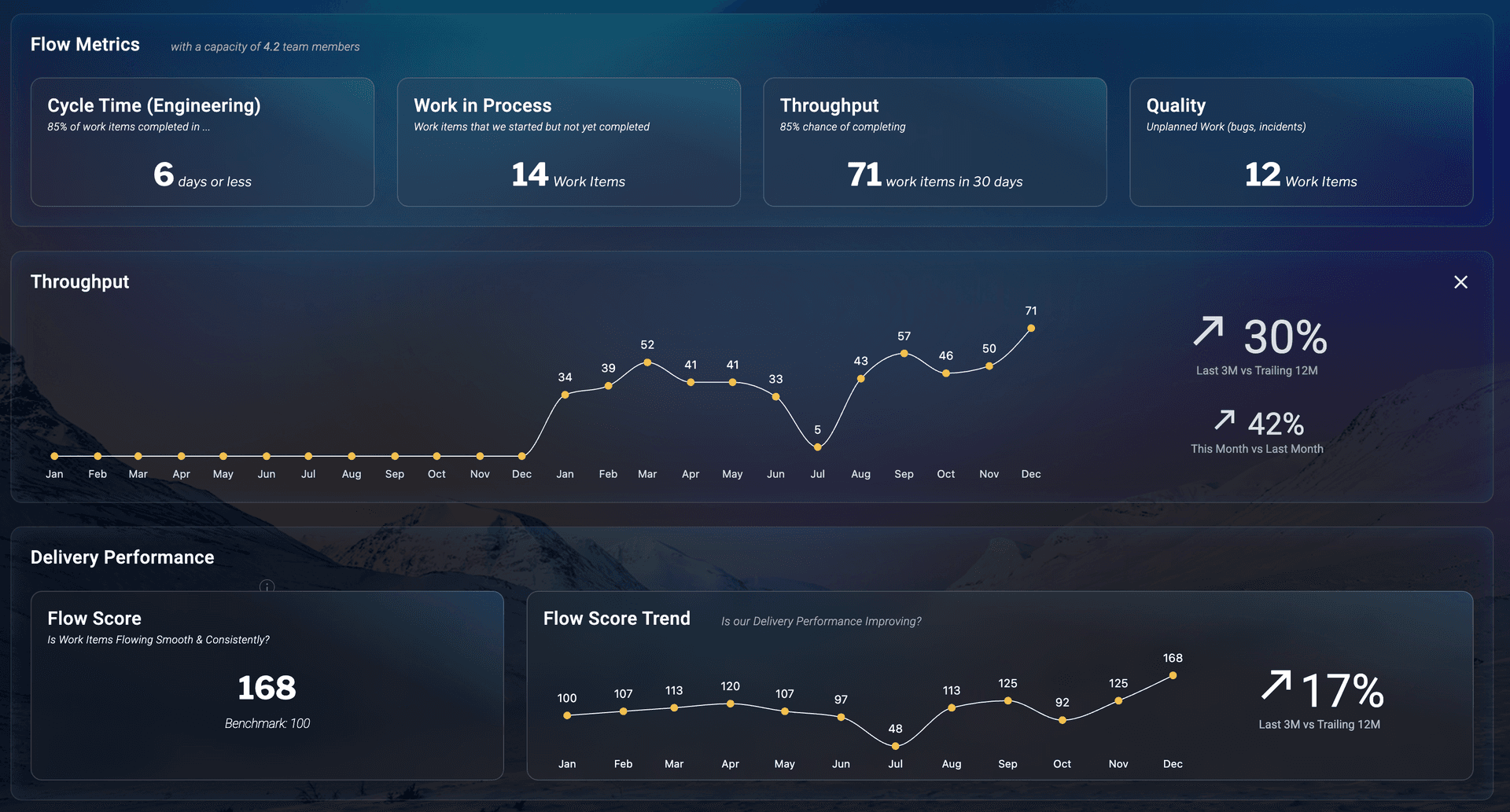
Cycle Time: 17 days to 6 days At the start 85% of the team's work items took 17 days to deliver value. Twelve months later that was down to 6 days. A 65% reduction in the time it takes for work to become value.
Throughput: 34 to 71 items per month The team went from completing 34 work items a month to 71. More than double the delivered output in the same team, in the same amount of time.
Quality: incidents down 30% Faster wasn't riskier. Production incidents fell by 30% over the same period.
Flow Score: 100 to 168 Our composite measure of how well value flows through a team rose 68% against baseline. This is the clearest single signal we have that habits and not heroics drove the improvement.
A different kind of contract
Results like these changed more than just the delivery, but they changed the commercial conversation with this client.
Instead of negotiating hours and a rate, we restructured the engagement around value:
Contract amount: reduced by 10%. The client pays 10% less overall.
Scope: increased by 25%. 25% more deliverables for that lower cost.
Net effect: a 35% change in value between the 2026 contract and the 2025 contract.
The client is paying less for more.
Proof, not projection
We promised ≈30% in our last post. This team delivered 35%.
This is what we see across most of our teams wherever the transformation has actually taken hold. One team, one contract, one client. The same story, repeated across the business.
The habits changed the work, that changed the numbers, that changed the contract. And the contract is now a promise we can make to every client, because we've already kept it to most of them.